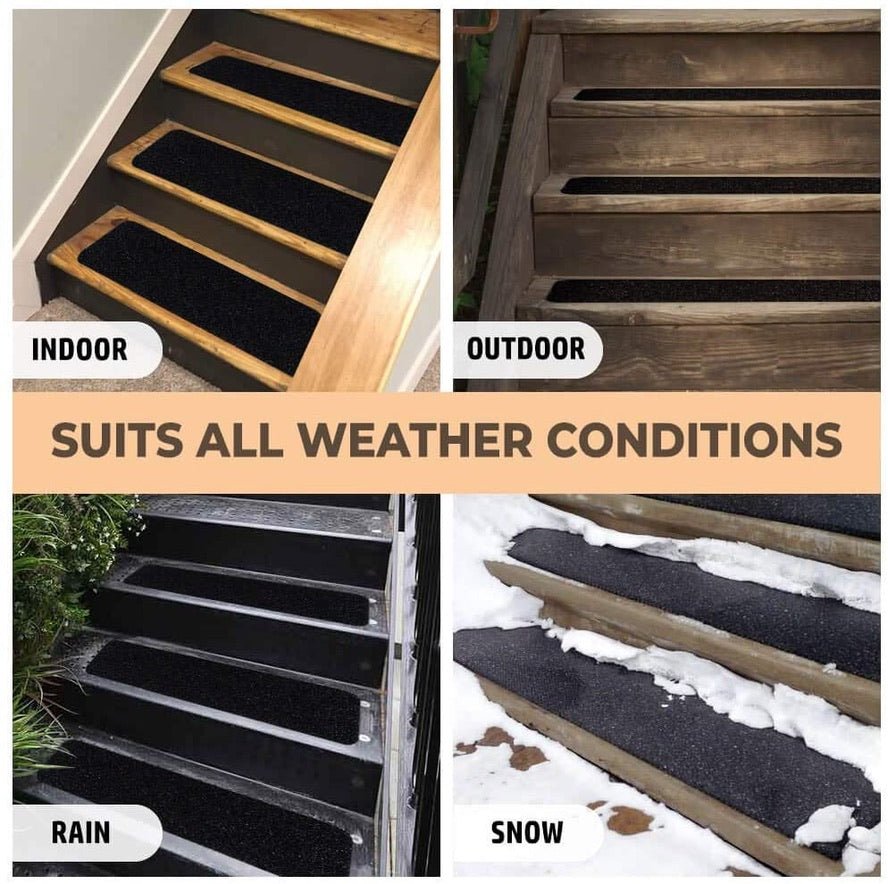


Anti-slip tape and anti-slip decking strips are surface-applied safety products that increase traction on wooden and composite decking to prevent slips and falls. The UK Health and Safety Executive (HSE) reports that slips, trips, and falls account for 29% of non-fatal workplace injuries, with residential decking contributing significantly to outdoor fall incidents during wet weather. Anti-slip tape uses pressure-sensitive adhesive backed with abrasive grit (typically aluminium oxide or silicon carbide) applied directly to deck boards, while anti-slip decking strips are rigid GRP (glass-reinforced plastic) or metal channels screwed onto deck surfaces. This article compares installation requirements, durability, cost, safety performance, and maintenance needs to determine which solution suits your decking type, traffic level, and climate conditions.
What Are Anti-Slip Tapes and How Do They Work?
Anti-slip tape is a pressure-sensitive adhesive strip with abrasive grit bonded to a flexible backing, applied directly to decking boards to increase surface friction and prevent slips. The tape consists of three layers: a durable PVC or aluminium foil backing, an aggressive acrylic adhesive layer (typically 0.2-0.5mm thick), and a surface layer of aluminium oxide or silicon carbide grit (60-80 grit size for standard applications, up to 36 grit for heavy-duty use). When pressure is applied during installation, the adhesive forms a molecular bond with the decking surface, while the exposed grit particles create microscopic contact points that increase the coefficient of friction.
Anti-slip tape works by increasing the surface roughness (Rz value) of decking boards. Standard wooden decking has an Rz value of 50-100μm, while anti-slip tape increases this to 300-500μm. The tape achieves PTV (Pendulum Test Value) scores of 40-50 under BS 7976 testing protocols, which classifies as "good" slip resistance (low slip risk begins at PTV 36). The flexible nature of tape allows it to conform to deck board contours, making it suitable for curved edges, steps, and irregular surfaces where rigid solutions fail.
What Are Anti-Slip Decking Strips and How Do They Work?
Anti-slip decking strips are rigid GRP or metal channels with integrated quartz grit, mechanically fixed to deck boards with screws to create permanent high-traction pathways. GRP (glass-reinforced plastic) strips contain 60-70% glass fibre content embedded in an isophthalic polyester resin matrix, with a quartz grit surface bonded during manufacture. The strips typically measure 50mm wide by 3-5mm thick, with pre-drilled holes at 300-400mm centres for mechanical fixing.
Decking strips achieve PTV scores of 60+ under BS 7976 testing, classifying as "excellent" slip resistance. The mechanical fixing method (stainless steel screws every 300mm) creates a permanent attachment that withstands temperature extremes from -40°C to +60°C without adhesive degradation. GRP strips have a load capacity exceeding 500kg per fixing point, making them suitable for commercial applications, wheelchair access ramps, and high-traffic public areas. Unlike tape, GRP strips do not rely on adhesive bonds, eliminating the primary failure mode of surface-applied anti-slip products.
Which Is Easier to Install: Tape or Strips?
Anti-slip tape installs in 30-60 minutes per 10 square metres requiring only surface cleaning and roller pressure, while decking strips require 2-3 hours for the same area including measuring, drilling, and screwing. The installation complexity differs significantly between the two.
Anti-Slip Tape Installation Process
Surface preparation determines tape adhesion quality. Clean the decking with a stiff brush and decking cleaner to remove algae, dirt, and oxidation. Allow 24-48 hours drying time since moisture content above 18% prevents proper adhesive bonding. Apply a surface primer or keying agent to smooth or weathered wood to improve adhesion by 40-60%. Install when ambient temperature is between 10°C and 30°C; below 10°C the adhesive remains too viscous, above 30°C it skins too quickly.
Peel back 50mm of backing paper, position the tape, and apply firm pressure using a roller presser to achieve 100% surface contact. Continue peeling and pressing in 300mm increments to prevent air bubbles. Seal edges with edge fix sealer to prevent water ingress that causes lifting.
Decking Strip Installation Process
Mark strip positions at 400-600mm centres across the deck. Pre-drill holes through the strips and into the decking to prevent splitting. Fix with stainless steel screws (typically 4.5mm x 40mm) at 300mm centres. Countersink screws flush with the strip surface to prevent trip hazards. Installation requires a drill, screwdriver, saw (for cutting strips to length), measuring tape, and pencil.

Which Lasts Longer: Anti-Slip Tape or Decking Strips?
Anti-slip tape lasts 1-3 years in residential use and 6-12 months in commercial high-traffic areas, while GRP decking strips maintain effectiveness for 10+ years with minimal degradation. The lifespan differential stems from fundamental differences in material composition and attachment methods.
Factors Affecting Tape Longevity
UV exposure degrades the PVC backing and adhesive within 18-24 months, causing brittleness and delamination. Heavy rain and freeze-thaw cycles accelerate adhesive failure at edges. Temperature fluctuations above 40°C soften the adhesive, allowing tape creep and edge lifting. Grit wear occurs progressively so when the surface feels smooth rather than abrasive a replacement is required. High-traffic areas (50+ daily footfalls) show wear patterns within 6 months.
Factors Affecting Strip Longevity
GRP decking strips resist UV degradation through UV-stabilised resin formulations. The quartz grit is embedded throughout the strip thickness (not just surface-coated), maintaining slip resistance even as surface wear occurs. Mechanical fixing eliminates adhesive failure modes. Stainless steel fixings resist corrosion for 15+ years in coastal environments. Strips require replacement only when physical damage occurs (cracking from impact, vandalism) or when the grit layer wears through after 10-15 years of heavy use.
Which Costs Less: Tape or Strips?
Anti-slip tape costs £8-15 per square metre versus £25-40 per square metre for GRP decking strips (materials only, excluding labour). The 10-year total cost of ownership reverses this comparison when lifespan is factored.
Initial Cost Comparison
|
Cost Component |
Anti-Slip Tape |
Decking Strips |
|
Materials per m² |
£8-15 |
£25-40 |
|
Ancillary products (primer, sealer, tools) |
£3-5/m² |
£2-3/m² |
|
Labour (DIY) |
£0 |
£0 |
|
Professional installation |
£10-15/m² |
£20-30/m² |
|
Total Initial Cost |
£11-35/m² |
£47-73/m² |
10-Year Cost Analysis
Tape requires replacement every 2-3 years in residential settings. Over 10 years, this equates to 4-5 replacement cycles. Total 10-year cost for tape: £44-175/m² (DIY) or £84-350/m² (professional). Decking strips require zero replacement over 10 years: £47-73/m² total cost. For high-traffic commercial applications, tape requires annual replacement, making decking strips the economical choice within 2-3 years despite the higher upfront investment.
Which Performs Better in Wet and Cold Conditions?
GRP decking strips achieve PTV scores of 60+ (excellent grip) in wet conditions, while anti-slip tape achieves PTV scores of 40-50 (good grip). Both solutions significantly improve upon untreated decking, which achieves PTV scores of 20-30 (high slip risk) when wet.
Slip Resistance Standards
BS 7976 (the UK standard for pendulum slip resistance testing) classifies surface safety as follows:
- PTV 0-24: High slip risk
- PTV 25-35: Moderate slip risk
- PTV 36+: Low slip risk (acceptable for public areas)
- PTV 60+: Excellent slip resistance
The DIN 51130 ramp test provides R-ratings (R9-R13) where R11+ is required for external walkways. Quality anti-slip tape achieves R11-R12 ratings, while GRP decking strips achieve R12-R13 ratings.
Cold Weather Performance
Anti-slip tape maintains adhesion down to -10°C but becomes brittle below -20°C, risking cracking and delamination. GRP strips function effectively from -40°C to +60°C without material degradation. In snow and ice conditions, both solutions provide traction improvement, though strips' raised profile (3-5mm) provides better ice-breaking capability than tape's flush profile.
Which Should You Choose for Your Deck?

Choose anti-slip tape for low-traffic residential decking where budget constraints exist and temporary solutions are acceptable. Choose GRP decking strips for high-traffic areas, commercial applications, and where long-term durability justifies higher initial investment. Here is a table to help make a decision.
|
Scenario |
Recommended Solution |
Reasoning |
|
Residential deck, <20 daily users, budget priority |
Anti-slip tape |
Lower upfront cost suits limited use |
|
Commercial premises, public access |
Decking strips |
10+ year lifespan, compliance liability |
|
Wheelchair ramps, accessibility routes |
Decking strips |
PTV 60+ meets DDA requirements |
|
Temporary/event decking |
Anti-slip tape |
Easy removal, lower commitment |
|
Coastal/marine environment |
Decking strips |
Corrosion-resistant, UV-stable |
|
Listed buildings, aesthetic priority |
Anti-slip tape |
Lower visual impact, reversible |
|
Steps with high fall risk |
Decking strips + GRP stair nosings |
Maximum edge visibility and grip |
Traffic Level Guidelines
- Light traffic (<20 footfalls/day): Tape lasts 2-3 years
- Medium traffic (20-50 footfalls/day): Tape lasts 1-2 years; strips recommended
- Heavy traffic (50+ footfalls/day): Strips essential; tape requires 6-monthly replacement
How Do You Maintain Anti-Slip Tape vs Strips?
Anti-slip tape requires annual inspection and replacement every 1-3 years, while GRP decking strips require biannual cleaning and inspection with replacement only after 10+ years. Maintenance procedures differ significantly between the two solutions.
Anti-Slip Tape Maintenance
Clean tape surfaces monthly with a stiff brush and mild detergent to prevent algae buildup that reduces grip. Inspect quarterly for edge lifting, adhesive failure, and grit wear. Replace tape when:
- Surface feels smooth (grit worn away)
- Edges lift more than 5mm
- Visible cracking or UV degradation appears
- PTV testing shows scores below 36
Apply fresh edge fix sealer annually to prevent water ingress. Remove old tape by heating with a heat gun (80-100°C) to soften adhesive, then scrape residue with a plastic scraper. Clean surface thoroughly before reapplication.
Decking Strip Maintenance
Clean strips biannually with pressure washing (low setting) or stiff brushing. Inspect fixings annually for loosening caused by wood expansion/contraction—tighten screws if heads protrude. Check for grit wear after 5+ years; strips remain effective until quartz layer wears through (typically 10-15 years). Replace individual strips if physical damage occurs. The screw holes from removed strips can be filled with exterior wood filler and sanded smooth if complete removal is required.
Comparison Table: Anti-Slip Tape vs Decking Strips
|
Feature |
Anti-Slip Tape |
Anti-Slip Decking Strips |
|
Installation Time |
30-60 min per 10m² |
2-3 hours per 10m² |
|
Tools Required |
None (roller optional) |
Drill, screws, saw |
|
Initial Cost |
£8-15/m² |
£25-40/m² |
|
10-Year Total Cost |
£44-175/m² |
£47-73/m² |
|
Lifespan |
1-3 years |
10+ years |
|
Slip Rating (PTV) |
40-50 (good) |
60+ (excellent) |
|
BS 7976 Classification |
Low slip risk |
Excellent slip resistance |
|
DIN 51130 Rating |
R11-R12 |
R12-R13 |
|
Temperature Range |
-10°C to +40°C |
-40°C to +60°C |
|
Best For |
Low traffic, budget |
High traffic, longevity |
|
Weather Resistance |
Moderate |
Excellent |
|
Aesthetic Impact |
Low profile, various colours |
Visible strips, industrial |
|
Removal |
Heat gun and scraper |
Unscrew and fill holes |
|
Load Capacity |
Adhesion limited |
500kg+ per fixing |
Conclusion
Anti-slip tape and decking strips both prevent slips on decking, but serve different use cases. Tape offers lower upfront cost (£8-15/m²) and easier installation (30-60 minutes per 10m²) but requires replacement every 1-3 years. Decking strips cost more initially (£25-40/m²) and take longer to install (2-3 hours per 10m²) but last 10+ years with minimal maintenance.
For residential decking with light traffic and budget constraints, anti-slip tape provides adequate safety improvement at accessible cost. For commercial premises, high-traffic areas, wheelchair access routes, and applications where long-term durability justifies investment, decking strips deliver superior PTV scores (60+), weather resistance (-40°C to +60°C), and total cost of ownership advantages.
Both solutions require proper installation to achieve rated performance. Use surface primer and roller presser for tape installation; use stainless steel fixings at 300mm centres for strip installation. Apply edge fix sealer to tape edges and inspect both solutions regularly to maintain slip resistance compliance with HSE guidance and BS 7976 standards.
Ready to make your decking safer? Browse our anti-slip tape collection for budget-friendly solutions or explore our non-slip decking strips for permanent high-traffic applications. For step edges and staircases, consider adding GRP stair nosings for maximum visibility and grip.
Frequently Asked Questions
Can you put anti-slip tape on decking?
Yes, anti-slip tape can be applied to wooden and composite decking. Clean the surface thoroughly, apply a keying agent if the wood is weathered, then press the tape firmly using a roller for full adhesion. Expect 1-3 years of service life in residential use.
How long does anti-slip tape last on decking?
Anti-slip tape lasts 1-3 years on residential decking with moderate foot traffic, and 6-12 months in commercial high-traffic areas. UV exposure, heavy rain, and temperature fluctuations reduce lifespan. Inspect annually and replace when grit wears smooth.
Are decking strips better than anti-slip tape?
Decking strips are better for high-traffic areas and long-term durability, lasting 10+ years versus 1-3 years for tape. However, tape is better for budget-conscious projects and low-traffic areas, costing 60-70% less upfront.
What is the best non-slip material for decking?
GRP (glass-reinforced plastic) with integrated quartz grit provides the best slip resistance, achieving PTV scores of 60+ (excellent grip). For adhesive solutions, aluminium oxide tape with 60-80 grit offers PTV scores of 40-50 (good grip).
How do you prepare decking for anti-slip tape?
Clean the decking with a stiff brush and decking cleaner to remove algae and dirt. Allow to dry completely (24-48 hours). Apply a keying agent to smooth or weathered wood. Install when temperature is between 10°C and 30°C for optimal adhesion.
Can anti-slip decking strips be removed?
Yes, decking strips can be removed by unscrewing the fixing screws. Fill the screw holes with exterior wood filler and sand smooth. GRP strips may leave a colour difference where the decking was protected from UV weathering.
What is BS 7976 and why does it matter?
BS 7976 is the British Standard for pendulum slip resistance testing, the recognised method for measuring floor surface slip resistance in the UK. PTV scores above 36 indicate low slip risk. HSE guidance recommends PTV testing for all external walkways in commercial premises.
Do I need professional installation for decking strips?
Professional installation is not required for competent DIYers. Decking strip installation requires basic tools (drill, screwdriver, saw) and takes 2-3 hours per 10m². Professional installation costs £20-30/m² and includes warranty coverage.